|
Still relying on annual stock counts to find inventory discrepancies? Discover how RFID can provide more frequent inventory visibility, reduce manual counting and help Malaysian warehouses move towards smarter stock management.
.png) 📡 Can RFID Really Eliminate Annual Stock Counts? What Malaysian Warehouses Need to Know
📡 Can RFID Really Eliminate Annual Stock Counts? What Malaysian Warehouses Need to Know
📦 Can RFID Really Eliminate Annual Stock Counts?
.png)
Imagine your warehouse has tens of thousands of items.
Once a year, the operation slows down.
Staff print inventory lists.
They walk through every aisle.
They count products.
They scan barcodes.
They compare physical quantities against the system.
Then someone discovers a discrepancy.
And suddenly, the team has to start searching.
For many warehouses, annual stock counting is still a major operational exercise.
But with RFID becoming more accessible, one question is becoming increasingly common:
“If we implement RFID, can we finally stop doing annual stock counts?”
The short answer?
Not completely.
But RFID can fundamentally change how often you count, how much manpower you need, and how quickly you can identify discrepancies.
⚡ In Short: RFID Reduces the Need for Heavy Stock Counting
RFID can automatically identify multiple tagged items within reading range without requiring workers to scan every individual barcode.
This means warehouse teams can perform faster inventory checks and more frequent cycle counts.
Zebra's warehouse solutions also support RFID-based inventory verification, including handheld RFID readers that can identify tagged goods from a distance.
So instead of relying on one huge annual stock count to discover inventory problems, businesses can move towards:
Frequent checking → Faster discrepancy detection → Better inventory visibility → Less disruption
The goal isn't necessarily to “eliminate counting.”
The goal is to make inventory accuracy a continuous process instead of a once-a-year event.
🚨 Why Annual Stock Counts Become a Problem
.png)
Annual stock counting sounds simple.
But in a large warehouse, it can become a major operational disruption.
1️⃣ Too Much Manpower
Traditional stock counting requires employees to physically move around the warehouse and verify inventory item by item.
The larger the warehouse, the more people and hours are required.
A Malaysian RFID inventory case study, for example, reported a reduction in full inventory counting time from three days to four hours after implementing RFID-based inventory automation.
The exact result will vary depending on the warehouse, tagging method, layout and system.
But the principle is clear:
Automated data capture can significantly reduce manual counting effort.
2️⃣ Inventory Changes While You Are Counting
Here's another problem.
Your warehouse isn't frozen in time.
While one team is counting:
📦 Goods may be received.
🚚 Orders may be picked.
🔄 Stock may be transferred.
📤 Products may be dispatched.
This creates another challenge:
The physical stock position can change while the counting process is still happening.
The longer the stocktake takes, the harder it becomes to maintain a clean comparison between physical inventory and system records.
3️⃣ Finding the Discrepancy Can Take Longer Than Finding the Stock
Imagine your system says:
500 units
But the physical count shows:
485 units
Where are the missing 15?
Now the team has to investigate.
Were they:
- Misplaced?
- Stored in another location?
- Not recorded during receiving?
- Already picked?
- Damaged?
- Transferred?
- Incorrectly counted?
This is where inventory visibility becomes more important than simply knowing the final quantity.
📡 So, How Does RFID Change the Process?
.png)
Barcode scanning usually requires a worker to point the scanner at each barcode.
RFID works differently.
RFID tags can be detected by an RFID reader when they are within its reading range, allowing multiple tagged items to be identified without individually scanning every barcode.
For warehouse inventory, this can make a major difference.
Instead of:
Find item → Aim scanner → Scan → Record → Move to next item
The process can become closer to:
Move through area → Read multiple tags → Compare data → Investigate exceptions
This makes RFID particularly useful for:
📦 Pallets
📦 Cartons
📦 Finished goods
📦 Raw materials
📦 High-value assets
📦 Large-volume inventory
Zebra's warehouse portfolio includes RFID handheld readers designed for inventory and cycle-counting applications, alongside barcode scanners and mobile computers.
🧠 RFID Doesn't Mean “Never Count Again”
This is the important part.
RFID should not be sold as a magic replacement for every inventory control process.
There are still situations where physical verification may be required.
For example:
- RFID tags may not have been applied correctly.
- Some items may not be RFID-tagged.
- Certain materials or environments can affect RFID performance.
- Damaged or missing tags can create exceptions.
- System records still need to be accurate.
- Businesses may still require periodic physical verification for audit or control purposes.
So instead of asking:
❌ “Can RFID eliminate stock counts?”
A better question is:
✅ “Can RFID reduce our dependence on large, disruptive stock counts?”
In many suitable warehouse environments, the answer can be yes.
🔄 From Annual Stocktake to Continuous Inventory Control
This is where RFID becomes more interesting.
Instead of waiting until the end of the year to discover inventory discrepancies, businesses can perform more frequent checks.
For example:
Traditional approach
Annual stock count
↓
Find discrepancies
↓
Investigate
↓
Correct records
↓
Wait until the next major stocktake
RFID-enabled approach
Daily / weekly / scheduled inventory checks
↓
Capture RFID data
↓
Identify exceptions
↓
Investigate immediately
↓
Maintain better inventory visibility
Zebra also highlights cycle counting as a way to supplement annual physical inventory counts and identify discrepancies more frequently.
That changes the role of stock counting.
Instead of being a big annual event, inventory verification becomes part of normal warehouse operations.
🏭 Where Zebra RFID Fits In
.jpg)
Zebra Technologies provides RFID hardware and warehouse technologies designed to support inventory visibility and data capture.
Depending on the application, a Zebra RFID solution can include:
📡 RFID handheld readers
🏷️ RFID tags and labels
🖨️ RFID printers/encoders
📱 Mobile computers
📊 Inventory software
🔗 Integration with warehouse systems
The important point is that RFID hardware alone does not automatically solve inventory problems.
The captured data needs to become useful operational information.
⚙️ Zebra RFID + AGen: From Data Capture to Action
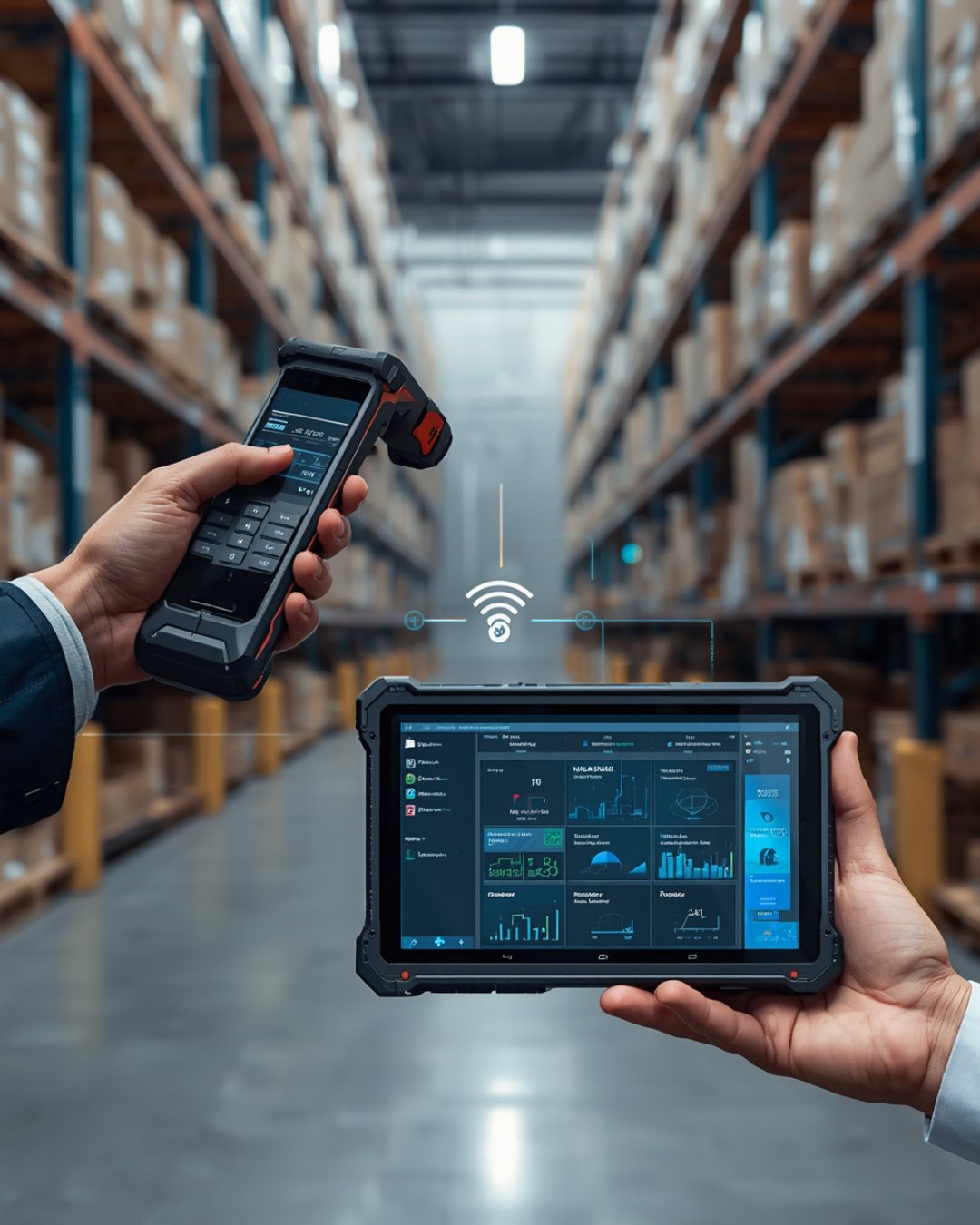
This is where ALC-Tech can add value beyond simply supplying hardware.
Zebra RFID captures the inventory data.
AGen helps turn that data into an operational workflow.
For example:
📦 Inventory Management
Monitor stock quantities and inventory movements.
📍 Location Tracking
Improve visibility of where inventory is stored.
🔄 Stock Movement
Record receiving, transfers, picking and dispatch activities.
📊 Inventory Verification
Compare expected inventory against captured inventory data.
⚠️ Exception Management
Identify discrepancies that require investigation.
📈 Management Visibility
Give supervisors and managers access to useful inventory information.
This creates a more complete approach:
RFID → Data Capture → AGen → Inventory Visibility → Action
Rather than simply replacing one counting method with another.
📊 What Can a Warehouse Gain?- Traditional Stock Counting RFID-Enabled Inventory Control
- Manual item-by-item scanning Multiple RFID tags can be detected
- Large counting events More frequent inventory checks
- High manpower requirement Reduced manual effort
- Discrepancies discovered late Faster discrepancy identification
- Operational disruption Less disruption potential
- Limited visibility between counts Better ongoing inventory visibility
The actual improvement depends on the warehouse layout, RFID tag placement, product materials, reading environment and software integration.
🇲🇾 Is RFID Suitable for Malaysian Warehouses?
RFID can be particularly worth considering for businesses managing:
🏭 Manufacturing inventory
📦 Distribution centres
🚚 Logistics operations
🛒 Retail inventory
🥫 FMCG products
🔧 Industrial components
📋 High-value assets
📦 Large-volume stock
It can be especially useful when businesses are struggling with:
“We have too much stock to count manually.”
“Our stocktake takes too long.”
“The system says we have it, but we can't find it.”
“We discover discrepancies only during the annual audit.”
“We need better inventory visibility without adding more manpower.”
🤔 But Does Every Warehouse Need RFID?
No.
And that's important.
If your warehouse has:
Low inventory volume
Few SKUs
Simple storage processes
Low transaction frequency
Minimal discrepancy issues
A good barcode scanning solution may already be sufficient.
RFID becomes more compelling when the volume, frequency and cost of inventory management justify greater automation.
The right solution should therefore start with the warehouse process — not the technology.
🚀 The Bigger Goal Isn't “No More Stock Counts”
The real goal is:
Know what you have.
Know where it is.
Know when it moved.
Know when something doesn't match.
And most importantly:
Know before the discrepancy becomes a bigger problem.
RFID can help businesses move away from a warehouse where inventory accuracy is checked only occasionally toward one where inventory visibility is continuously improved.
That is a much more realistic way to think about RFID.
🚀 Stop Waiting for the Annual Stocktake to Find Inventory Problems

Your warehouse shouldn't need one massive stock count just to discover that inventory has gone missing, moved to the wrong location or no longer matches the system.
With the right combination of RFID, barcode technology, mobile computing and warehouse software, businesses can move towards faster verification, better visibility and more proactive inventory control.
The future of inventory management isn't simply counting faster.
It's knowing what is happening to your inventory before you need to count everything.
👉 Looking for Zebra RFID and warehouse inventory solutions?
Zebra Solutions:
https://www.alcaidc.com/Public/ProductGroupBrand.aspx?ItemGroup=1004&Brand=ZEBRA
❓ Frequently Asked Questions
1. Can RFID completely eliminate annual stock counts?
Not necessarily. RFID can significantly reduce manual counting effort and support more frequent inventory verification, but businesses may still require periodic physical verification depending on their processes, audit requirements and inventory environment.
2. Is RFID faster than barcode stock counting?
RFID can be faster for suitable applications because multiple RFID tags can be identified within the reader's range without individually scanning each barcode.
3. Does RFID improve inventory accuracy?
It can help reduce manual data-capture errors and provide better inventory visibility, but accuracy still depends on correct tagging, system integration, processes and exception handling.
4. Can RFID find missing inventory?
RFID can help locate tagged inventory and identify discrepancies between expected and detected stock, reducing the amount of time spent searching manually.
5. Is RFID suitable for Malaysian warehouses?
Yes. RFID can be applied across manufacturing, logistics, distribution, retail and other industries where businesses manage high-volume inventory or require stronger inventory visibility.
6. Should I use RFID or barcode scanners?
It depends on the operation. Barcode scanning is often a practical and cost-effective choice for many warehouses, while RFID becomes more attractive when businesses need faster multi-item identification, automation and greater inventory visibility.
📥 Explore More:
Discover ALC-Tech's solutions for:
- Zebra RFID Solutions
- RFID Inventory Tracking
- Warehouse Inventory Management
- Barcode Scanning Solutions
- Mobile Computers
- Warehouse Management Systems
- Stock Taking & Cycle Counting
- Inventory Control Systems
- Warehouse Automation
- Real-Time Inventory Visibility
- AGen Digital Warehouse Solutions
Download the ALC-Tech Solutions Brochure:
https://www.alcaidc.com/Public/Brochure/BrochureSolution.aspx
By:
kavi
| Date:
10 Sep2026
|